Recorded at the Studios of Industrial September 1979.
5000 copies only on Industrial

Tunisian oud (middle eastern lute) player and composer who is widely regarded as an innovator in his field. Performing for primarilly a jazz audience, he fuses Arabic classical music, folk music and jazz and has been recording since at least 1991 after becoming prominent in his own country in the late 1980s.
Brahem began studying the oud at age 10 under the tutelage of Ali Sitri at the National Conservatory of Music in Tunis. In 1987, after six years in Paris, he spent two years as the director of the Ensemble Musical De In Ville De Tunis. ECM released his first album (not counting a cassette self-release in his youth) in 1991, called Barzakh.
In playing style, Anouar Brahem is often compared to Rabih Abou-Khalil, though his compositions tend to be more mellow and spare. Most often he utilizes an ensemble of three or four musicians. He has collaborated throughout his career and on several albums with other musicians: Tunisian percussionist Lassad Hosni and violinist Bechir Selmi and Turkish clarinetist Barbaros Erkose. He has also performed live concerts with these same ensembles. In addition to these, he worked together with many jazz musicians such as Jan Garbarek, Dave Holland and John Surman. Brahem also played with Paola Damiani’s Orchestre National de Jazz. In his last album, Le Voyage De Sahar (2006), he has come together again with pianist Francois Couturier and accordionist Jean Louis Matinier. Couturier and Matinier - two very talented musicians- played before in Brahem’s Le Pas Du Chat Noir (2002).
DOWNLOAD----->
Etiquetas: Arabic, Jazz, World Music.
What with the recent rise of Benin-born guitarist Lionel Loueke into the ranks of the jazz scene, bolstering a precedent set by fluid Cameroonian-in-Brooklyn electric bass wonder Richard Bona, a new mini-movement of instrumentally virtuosic and vocally expressive African-jazz artists on major labels is upon us. Bona’s fifth and latest album—his first live recording—further confirms what we already know: Bona is one of the master electric bassists in our midst, not to mention a vocal conjurer with a natural flair, but one who tends to adopt the garb of sweet-spirited, unpretentious entertainer in his role as solo artist.
With his solid quintet, Bona not only traverses sultry African grooves and flavors, but taps into organic and culturally aligned Afro-Latin strains in the African Diaspora. But it’s not as if he’s out to assert any musical history lessons on the job. Bona pays brief homage to his former employer and kindred spirit Joe Zawinul (who passed away shortly after this recording was made) with the keyboardist’s elliptical tune “Indiscretions.” But the Zawinul-iana is used as a somewhat contrarian introduction to Bona’s buoyant and Al Jarreau-ish vocal tune “Please Don’t Stop.” To be sure, Bona is an extra-limber singer, and weaves in more supple vocal chops on the album than bass bedazzlement, particularly on the a cappella (plus deft looping/harmonizing) workout of “Samaouma.”
For all his deep-dish musicality and capacity for virtuosity on tap, in his role as a bandleader, Bona likes to keep the party rolling and the material on the simple, celebratory side. It’s hard to complain about his life-affirming attitude and anti-elitist entertainer’s instincts, but some of us long for at least a little bit of the kind of intellectual and dexterous firepower he’s capable of, which Zawinul might have called the stuff of “brain attacks.”(Josef Woodard)
DOWNLOOOOOAAAAAAAAD....
Etiquetas: Jazz
Etiquetas: Jazz
Etiquetas: Jazz
Etiquetas: Jazz
Etiquetas: Jazz
Etiquetas: Jazz
Etiquetas: Jazz

A show of Soul and virtuosity by the means of modern saxophone-playing.
SoundsLike: Jazz-Funk, SexySaxPlaying
Etiquetas: contemporary, Jazz
Triangulation is an intriguing trio combination. Multi-reed master Vinny Golia and trombonist George Lewis seem an obvious enough match, both having worked with Anthony Braxton and sharing a musical approach that at least overlaps in part. Bassist Bertram Turetzky, however, is better known as an outstanding contemporary classical interpreter of modern music for the double bass, so his appearance on the freely improvised session is something of a surprise, though a very pleasant one. Golia, one of the rare regular practitioners of the bass sax, spends a good bit of time with that unwieldy axe, conjuring up dark, rich soundscapes in tandem with Turetzky's brooding arco work. Lewis is his typical fleet self in upper and lower registers, dancing gamely between his partners and providing some of the finer single moments on the album. Creative improv album and one that fans of any of the participants are likely to savor.
Etiquetas: contemporary, free jazz, Jazz
Etiquetas: classic, contemporary, Jazz
Etiquetas: Jazz
Etiquetas: Jazz
Etiquetas: Jazz, Jazz-Fusion
Etiquetas: Jazz
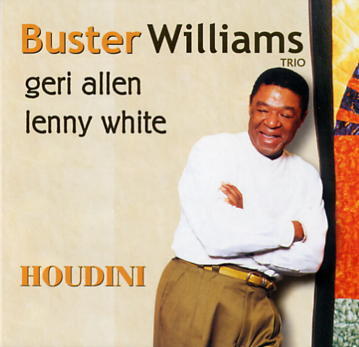
Another strong entry in Buster Williams' substantial catalog as a leader. The master bassist opts for a trio this time rather than a quartet, but retains his regular cohorts Geri Allen on piano and Lenny White on drums. Impressionistic and meditative yet explosively swinging, the record is a must for fans of Allen's playing. In addition to playing several original compositions by Williams, the trio puts a sophisticated spin on "If I Should Lose You" and "Little Girl Blue." (The latter is actually a bass/piano duet.) They also pore over two gems from the Miles Davis second quintet book, "The Sorcerer" (by Herbie Hancock) and "Fall" (by Wayne Shorter). Of the originals, "Bellodgia Diva," with its flowing theme and simple harmonic structure, becomes quickly etched in the brain, while "Ouija Board" and the two-part title track offer more abstract pleasures. As a whole, Houdini represents the height of excellence in the piano trio idiom.
Etiquetas: Jazz