


Mostrando entradas con la etiqueta classic. Mostrar todas las entradas
Mostrando entradas con la etiqueta classic. Mostrar todas las entradas

Jimi Hendrix / Are You Experienced?
21 septiembre 2009 |
|
0
comentarios

Are You Experienced is the album debut for THE JIMI HENDRIX EXPERIENCE
It was a great record¡¡¡¡¡
Psychedelic, Rithym & Blues
Released 1967
Jimi Hendrix, Mitch Mitchell & Noel
Redding.
Enjoy this Album & Smoke Hierba
***Download***

King Crimson / In The Court Of The Crimson King
15 junio 2009 |
|
0
comentarios

In the Court of the Crimson King is the 1969 debut album by the British progressive rock group King Crimson. The album is generally considered by many to be the launching point of progressive rock where blues-oriented rock was mixed together with jazzy and European symphonic elements. Maybe one of the all-time most influential albums. The Who’s Pete Townshend was quoted as calling the album “an uncanny masterpiece”.
The album was remastered and re-released on vinyl and CD several times during the 1980s and 1990s. The original stereo master tapes were finally located in a Virgin Records storage vault in 2003, leading to a much improved remastered CD version released in 2004.
Barry Godber (1946–1970), an artist and computer programmer, painted the album cover. Godber died in February 1970 of a heart attack, shortly after the album’s release. It would be his only painting, and is now owned by Robert Fripp.
Original Track Listing
Side one
1. “21st Century Schizoid Man” (Fripp, McDonald, Lake, Giles, Sinfield) – 7:21
including “Mirrors”
2. “I Talk to the Wind” (McDonald, Sinfield) – 6:05
3. “Epitaph” (Fripp, McDonald, Lake, Giles, Sinfield) – 8:47
including “March for No Reason” and “Tomorrow and Tomorrow”
Side two
1. “Moonchild” (Fripp, McDonald, Lake, Giles, Sinfield) – 12:13
including “The Dream” and “The Illusion”
2. “The Court of the Crimson King” (McDonald, Sinfield) – 9:25
DOWNLOAD
Yo-Yo Ma, Edgar Meyer, Mark O´Connor / Appalachian Journey
15 abril 2009 |
|
1 comentarios

The follow-up album to the highly successful Appalachia Waltz collaboration, Appalachian Journey continues the combination of classical music with Appalachian, bluegrass, and American roots music in general. Yo-Yo Ma, alongside violinist Mark O'Connor and bass player Edgar Meyer, runs through a number of original compositions fusing the traditions, as well as a few old standards from the genre repertoire. As stated by the artists, Appalachia Waltz explored the combination of the three artists' sounds put together, while Journey expands upon this theme, exploring the sound of the three artists as a singular group. Joining with the trio are James Taylor on a pair of works (on both guitar and vocals) and Alison Krauss on fiddle and vocals. The vocalists are added specifically on a pair of old Stephen Foster works, the songs themselves thematically bridging the gap between the classical and folk realms. The tone can change easily from cheerful jigging to outright nostalgic, depending largely on who's doing the soloing at any given time. There's an embracing down-home atmosphere set up by the artists, using warm tones and motives throughout the album. At the same time, the trio displays some remarkable virtuosity (as would be expected from this group), burning through some fiery sets of triplets on otherwise slow instruments (the cello and bass, specifically), but keeping up with the violin while avoiding the easily hit distortion sounds that usually come from high speed, low frequency playing. Reels fit easily with waltzes here, and also with traditional songs with virtuosic passages from original compositions. The old and the older are easily made compatible here largely on the strength of the performers involved. It's a worthwhile album for listeners curious about the newer directions being taken in the classical realm.
Arnold Schoenberg / Pierrot Lunaire
10 abril 2009 |
|
0
comentarios
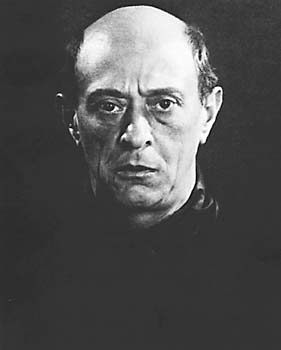
Dreimal sieben Gedichte aus Albert Girauds 'Pierrot lunaire', ("three times seven poems from Albert Giraud's 'Pierrot lunaire'"), commonly known as Pierrot Lunaire ("Moonstruck Pierrot" or "Pierrot in the moonlight"), Op. 21, is a melodrama by Arnold Schoenberg. It is a setting of twenty-one selected poems from Otto Erich Hartleben's German translation of Albert Giraud's cycle of French poems of the same name. The première of the work, which is between 35 and 40 minutes in length, was at the Berlin Choralion-saal on October 16, 1912, with Albertine Zehme as the vocalist.
The narrator (voice-type unspecified in the score, but traditionally performed by a soprano) delivers the poems in the Sprechstimme style, which complements the mood of the poems aurally. Schoenberg had previously used this combination of spoken text with instrumental accompaniment, called "melodrama", in the summer-wind narrative of the Gurre-Lieder, and it was a genre much in vogue at the end of the nineteenth century. The work is atonal, but does not use the twelve-tone technique that Schoenberg would devise eight years later.
There was some criticism of blasphemy in the texts, to which Schoenberg responded, "If they were musical, not a single one would give a damn about the words. Instead, they would go away whistling the tunes".
Steve Reich, Music for 18 musicians
27 marzo 2009 |
|
0
comentarios

If Steve Reich's Music for 18 Musicians is simply described in terms of its materials and organization — 11 chords followed by 11 pieces built on those chords — then it might seem utterly dry and monotonous. The actual music, though, is far from lackluster. When this recording was released in 1978, the impact on the new music scene was immediate and overwhelming. Anyone who saw potential in minimalism and had hoped for a major breakthrough piece found it here. The beauty of its pulsing added-note harmonies and the sustained power and precision of the performance were the music's salient features; and instead of the sterile, electronic sound usually associated with minimalism, the music's warm resonance was a welcome change. Yet repeated listening brought out a subtle and important shift in Reich's conception: the patterns were no longer static repetitions moving in and out of phase with each other, but were now flexible units that grew organically and changed incrementally over the course of the work. This discovery indicated a promising new direction for Reich, one that put him ahead of his peers by giving his music greater interest and adaptability and led to the more elaborate works of the next two decades.
Philip Glass, Wendy Sutter (cello), Songs and poems for solo cello
25 marzo 2009 |
|
0
comentarios

Songs and Poems for Solo Cello represents the solo recording debut of cellist Wendy Sutter featuring two world premieres. Premiered in 2007, Songs and Poems for Solo Cello is a seven-movement work by American composer Philip Glass. Known for large-scale theater works, film scores, concertos and symphonies, Songs and Poems for Solo Cello shows the composer at his most intimate. Also featured on the disc, Tissues, composed for the film Naqoyqatsi, are works written for cello, percussion and piano. Wendy Sutter is an internationally acclaimed soloist, most recently making for US premiere as soloist for the Philip Glass Cello Concerto. The cellist is also known as a long-time member of Bang on a Can All Stars. Songs and Poems for Solo Cello was recorded on the 1620 Ex-Vatican Stradivari.
Sofia Gubaidulina, Stimmen... Verstummen
19 marzo 2009 |
|
0
comentarios

Stimmen... Verstummen... is a symphony in twelve movements by Russian-Tatar composer Sofia Gubaidulina. It was written in 1986 and dedicated to the conductor Gennady Rozhdestvensky, who gave the first performance in West Berlin with the Moscow State Symphony Orchestra on September 4, 1986. It takes the two words of its title from a poem by Francisco Tanzer.
Stimmen... Verstummen... is primarily organized around two themes. The first is that of a major triad, occurring as D-major in the first, third, and fifth movements and as a G-major triad in the tenth and twelfth movements. The second theme, that of "effort and ruin", occurs in the second, fourth, and sixth movement. Movements I, III, V, and VII become progressively shorter according to the proportions of the Fibonacci sequence.
The symphony is notable for its careful and innovative use of silence. Though the eighth movement has the largest porportions of the work, the climax actually takes place in the ninth movement when the conductor motions before a silent orchestra. The motions the conductor makes are meant to make his hands move increasingly farther apart from each other according to the Fibonacci sequence. This "conductor solo" is repeated at the end of the work, when after the last note is sounded the conductor continues to motion for several minutes.
Stimmen... Verstummen... is primarily organized around two themes. The first is that of a major triad, occurring as D-major in the first, third, and fifth movements and as a G-major triad in the tenth and twelfth movements. The second theme, that of "effort and ruin", occurs in the second, fourth, and sixth movement. Movements I, III, V, and VII become progressively shorter according to the proportions of the Fibonacci sequence.
The symphony is notable for its careful and innovative use of silence. Though the eighth movement has the largest porportions of the work, the climax actually takes place in the ninth movement when the conductor motions before a silent orchestra. The motions the conductor makes are meant to make his hands move increasingly farther apart from each other according to the Fibonacci sequence. This "conductor solo" is repeated at the end of the work, when after the last note is sounded the conductor continues to motion for several minutes.
"I am a religious person...and by 'religion' I mean re-ligio, the re-tying of a bond...restoring the legato of life. Life divides man into many pieces...There is no weightier occupation than the recomposition of spiritual integrity through the composition of music." — Sofia Gubaidulina
The Kronos Quartet, Pieces Of Africa
|
|
0
comentarios

When released, Pieces of Africa was subject to some of the same "cultural imperialist" criticism that had been more successfully leveled at performers like David Byrne and Paul Simon. The album consists of commissions from African composers working at varying distances from European conventions. But whereas Byrne and Simon arguably used the music of Brazil or South Africa as backgrounds over which to display their own egos, the Kronos Quartet's members managed to sublimate themselves in service to the compositions, never giving the listener any sense of condescension. All of which is to say that Pieces of Africa is a very beautiful recording with several superb individual works. Zimbabwe's Dumisani Maraire's opening piece, "Mai Nozipo," with the composer accompanying the quartet on drums, is a rousing, triumphant anthem with a resonant melodic line that will long linger. Thematically, most of the pieces draw on African sources, very clearly in the case of the Arabic-infused songs of Hassan Hakmoun and the great Sudanese composer Hamza el Din. Unsurprisingly, South African Kevin Volan's "White Man Sleeps" comes closest to European traditions, though even this piece, which is gorgeous and inspired throughout, draws inspiration from native environmental sounds. The disc closes with another composition by Maraire, with an accompanying gospel choir making explicit the link between Africa's music and that of the American South. Pieces of Africa teems with beguiling melodies, making it one of this quartet's more accessible projects and also one of its best.
Francois Rabbath, Live Around the World
12 febrero 2009 |
|
0
comentarios
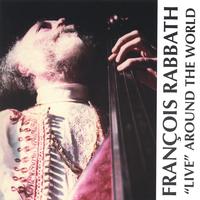
Every now and then, just when you thought you had things all neatly arranged in their proper order, someone comes along and not only upsets everything you've done, but demands that you change your entire way of thinking before you can even begin to put them back together again. François Rabbath is one of those people.
1 POUCHA-DASS. Raga inspired by the sound of the Indian Sitar.
2 ORDIS. In homage to Paganini and dedicated to Louis Gilbert
3 REITBA. Inspired by the magic of the African desert.
4 DESERT. The first composition of Rabbath. Inspired by the Jazz of the 60’s.
5 IMPALAS. The bouncing run of the gazelles.
6 ODE D’ESPAGNE. In the style of the Spanish guitar.
7 LA GUERRE ET LA PAIX. War and Peace, parts 3 and 4. Written for the celebration of Pablo Picasso’s 90th birthday, October 24, 1971 and Vallauris, France.
8 PRADES. In homage to Pablo Casals
9 KOBOLDS. The dancing gnomes playing music.
10 CRAZY COURSE. The crazy chase
11 IBERIQUE PENINSULAIRE or ESPOIR. Dedicated to Paco Ibanez in memory of the great Chilian poet Pablo Neruda, the third “Pablo” to die in 1973.
12 QUATION DU TEMPS. The measure of time.
13 CONCERTO NO.1. For solo double bass
14 ETE QUATE. Seven Four
15 BRIEZ. A study in electro-acoustic sonorities produced with the bow by natural and artificial harmonics.
16 CONCERTO NO.2
2 ORDIS. In homage to Paganini and dedicated to Louis Gilbert
3 REITBA. Inspired by the magic of the African desert.
4 DESERT. The first composition of Rabbath. Inspired by the Jazz of the 60’s.
5 IMPALAS. The bouncing run of the gazelles.
6 ODE D’ESPAGNE. In the style of the Spanish guitar.
7 LA GUERRE ET LA PAIX. War and Peace, parts 3 and 4. Written for the celebration of Pablo Picasso’s 90th birthday, October 24, 1971 and Vallauris, France.
8 PRADES. In homage to Pablo Casals
9 KOBOLDS. The dancing gnomes playing music.
10 CRAZY COURSE. The crazy chase
11 IBERIQUE PENINSULAIRE or ESPOIR. Dedicated to Paco Ibanez in memory of the great Chilian poet Pablo Neruda, the third “Pablo” to die in 1973.
12 QUATION DU TEMPS. The measure of time.
13 CONCERTO NO.1. For solo double bass
14 ETE QUATE. Seven Four
15 BRIEZ. A study in electro-acoustic sonorities produced with the bow by natural and artificial harmonics.
16 CONCERTO NO.2
Close To The Edge (Bonus Tracks) / Yes
02 febrero 2009 |
|
0
comentarios

"Essencial: A Masterpiece of Progressive Rock" - ProgArchives.com
In 1972 a masterpiece of progressive rock has born: Close To The Edge from Yes.
With this album Yes create a complete new stile on the prog rock, that trascends ages and times. Yes are one of the five pilars of the progressive rock besides Rush, ELP, King Crimson and Pink Floyd.
Close To The Edge is one of the most amazing albums that I'd ever heard, the combination of all the instruments are just perfect, The Wizard Of The Keyboards, Mr. Rick Wakeman always with that sense of aesthetic and technique. Jon Anderson with his angelical voice, Steve Howe with the virtuoso sound on the guitar, Chris Squire, with a deep and clear bass, and Bill Bruford, in his last colaboration with the band, making wonderful rhythms in the percussions.
Line-Up:
Jon Anderson - Vocals
Bill Bruford - Percussion
Steve Howe - Guitar, Vocals
Chris Squire - Bass, Vocals
Rick Wakeman - Keyboards
Tracklist:
1. Close To The Edge (18:42) :
i. The Solid Time Of Change
ii. Total Mass Retain
iii. I Get Up I Get Down
iv. Seasons Of Man
ii. Total Mass Retain
iii. I Get Up I Get Down
iv. Seasons Of Man
2. And You And I (10:08):
i. Cord Of Life
ii. Eclipse
iii. The Preacher The Teacher
iv. Apocalypse
ii. Eclipse
iii. The Preacher The Teacher
iv. Apocalypse
3. Siberian Khatru (9:00)
Bonus Tracks:
4. America [Single Version] (4:12)
5. Total Mass Retain [Single Version] (3:21)
6. And You And I [Alternate Version] (10:18)
7. Siberia [Studio Run-Through of "Siberian Khatru"] (9:19)
5. Total Mass Retain [Single Version] (3:21)
6. And You And I [Alternate Version] (10:18)
7. Siberia [Studio Run-Through of "Siberian Khatru"] (9:19)
Download & Enjoy Close To The Edge (88 Mb /192 Kbps)
Yes Is On Tour: LIve In Mexico February 5!!!!!!!!!!!!
Yann Tiersen, Les Retrouvailles
28 enero 2009 |
|
0
comentarios

Les Retrouvailles is an album by French musician Yann Tiersen. Released in 2005, it features a number of high-profile guest vocalists, both French and Anglophone alike: Christophe Miossec, Dominique A, Elizabeth Fraser (of the Cocteau Twins), Jane Birkin, and Stuart Staples (of the Tindersticks). As is customary with his albums, Tiersen showcases his multi-instrumental skills, which on the album encompasses the accordion, piano, mandolin, and harpsichord, among others.
Steve Reich, Different Trains (Kronos Quartet)
04 enero 2009 |
|
0
comentarios
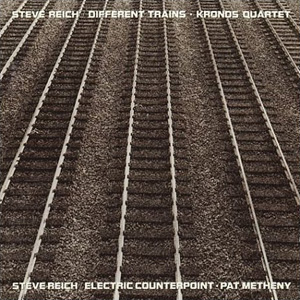
Mr. Reich's 1988 piece, Different Trains, marked a new compositional method, rooted in It's Gonna Rain and Come Out, in which speech recordings generate the musical material for musical instruments. The New York Times hailed Different Trains as "a work of such astonishing originality that breakthrough seems the only possible description....possesses an absolutely harrowing emotional impact." In 1990, Mr. Reich received a Grammy Award for Best Contemporary Composition for Different Trains as recorded by the Kronos Quartet on the Nonesuch label.
Olivier Messiaen, Turangalila Symphonie (Hans Vonk & Saint Louis Symphony Orchestra)
19 diciembre 2008 |
|
1 comentarios

"I first heard Messiaen when I was 15 or 16—the Turangalîla-Symphonie—and just found it magical, especially with the ondes martenot swooping around with the strings (who seemed to be playing an entirely different piece of music). I didn't know it was allowed to write music like that. Also, it was the fact that he was still alive, still writing. I just latched on to him, partly in reaction to all the schlemiels who only liked twee classical music, but mainly because it was such other-worldly music."
Jonny Greenwood
The Rascher Saxophone Quartet, Saxophone - Philip Glass
15 diciembre 2008 |
|
0
comentarios

The Rascher Saxophone Quartet carries on a tradition established in the 1930's by the pioneer of the classical saxophone and founding member Sigurd Rascher who animated many composers to write music especially for him. In a similar fashion the quartet has inspired over 250 composers to dedicate music to them including Glass, Berio, Gudaidulina, Wuorinen, Xenakis and others. All these composers have shared an enthusiasm for the four musician's unique homogenous tone quality and virtuosity.
John Cage, Sonatas and interludes for prepared piano (Boris Berman)
|
|
0
comentarios
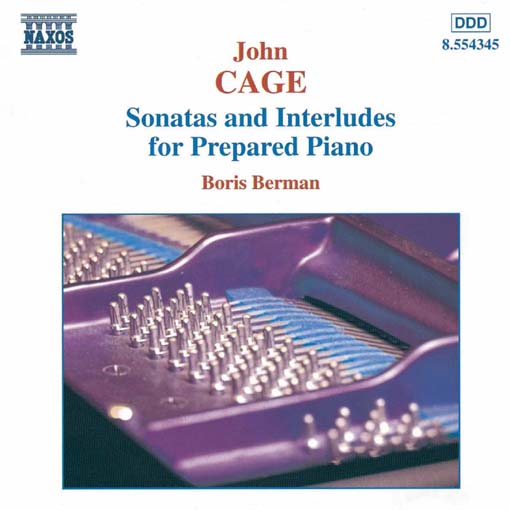
Cage's minimalist leanings and eventual teachings served to teach the avant-classical world much about the value of this kind of music, the importance of space, restraint and choice and these themes are all starkly evident here. An incredible and hugely important selection of work from one of the true musical greats of the 20th Century.
Sound like: contemporary music, minimalist
Avándaro! [La Ceremonia Cósmica]
12 diciembre 2008 |
|
0
comentarios

11 de Septiembre de 1971, Avándaro, Valle De Bravo, se calculaban 4,000 personas en la versión del Woodstock Mexicano, de a $25.00 la entrada, con una cartelera muy prometedora, aunque al principio unos patrocinadores bien pinches, nomás Coca-Cola y Stock Cars, era un Festival De Rock Y Ruedas.
Una reunión de un montón de Hippies, jóvenes trastocados por los golpes que les soltó el gobierno, ese mismo año y dos años atrás, el 2 de Octubre, Alex Lora, del Tri, que en esos ayeres se llamaban "Three Souls In My Mind", y no eran tan piñateros, recordará orgullosamente "Les dedicamos el concierto a la banda que mataron el dos de octubre, y ese mismo año..."
Oficialmente el concierto lo abrirán "Lod Dug Dug's" Una de las más grandes bandas de la época, para cuando los "Dug Dug's" subieron al escenario, la cifra delgada de los cuatro mil, se había superpasado hasta alcanzar el proximado de 250,000 asistentes, luego tocó Epilogo, Tequila, con Maricela López en lños vocales. Las púras épocas de la pachequés´, en las fotos de avándaro, igual que en las de Woodstock, los humos de la Plantita de Poder se veían un montón, imagínense el olor...

La Lista "oficial" de los participantes en total sería algo así:
Los Dug Dug's
El Epílogo
Peace And Love [que se dice que traían buena vibra, ya que con ellos fue con los que mejor funcionó todo, y los que más prendieron a la banda]
Peace And Love [que se dice que traían buena vibra, ya que con ellos fue con los que mejor funcionó todo, y los que más prendieron a la banda]
La Divicion Del Norte
Banda Tequila
El Ritual
Tinta Blanca
Los Yakis
El Amor
Three Souls In My Mind
Bandido
Bueno, es bastante incompleta, mucho del tiempo que se tocó fue fuera de lo establecido, la banda andaba prendidísimo, de aquí se desprenden la versión Genial de "Marihuana" de Peace and love, "I'm Gonna Move" de Tequila.
el Tracklist de el cachito de concierto que les dejo es el que sigue:
1.-Memorias Para Los Que se Han Ido - Peace And Love
2.-I'm Gonna Move -Tequila
3.- Let It Go - Ritual
4.- Sentimiento Latino - Peace And Love
5.- Tema De Bandido - Bandido
6.- Things Things - Dug Dug's
7.- Amor y Paz - Peace And Love
8.- Let's Make It Now - Dug Dug's
9.- I Got A Feelin' - Dug Dug's
10.- Tema Instrumental - Epílogo
11.- Satanás - Ritual
12.- New Day - la Divicion Del Norte
13.- Super Highway - tequila
14.- Do You Believe In Me - Tequila
15.- Prostituta - Ritual
16.- tenemos el Poder - Peace And Love
17.- Marihuana - Peace And Love.
Acá la portada del mismo disco:

Difrútenlo:
Descarga Desde Megaupload
106 mb / 128 Kbps
Y acuerdense de seguir las enseñanzas del maestro "Tommy", ese que se subió a presidir "La Ceremonia Cósmica"
Can/Ege Bayasi
08 diciembre 2008 |
|
1 comentarios

"Sin duda uno de los mejores discos del KrautRock y uno de los mejores exponentes de Alemania"
(United Artist, 1972)
Sounds Like:
Kraut Rock, Progresive
Tangerine Dream, Neu!
Download <<<
Suscribirse a:
Entradas (Atom)

LAOS

some art, some bullshit
Fuck Pop Culture!

Click to get
Brothers Blogs


Follow Us!
